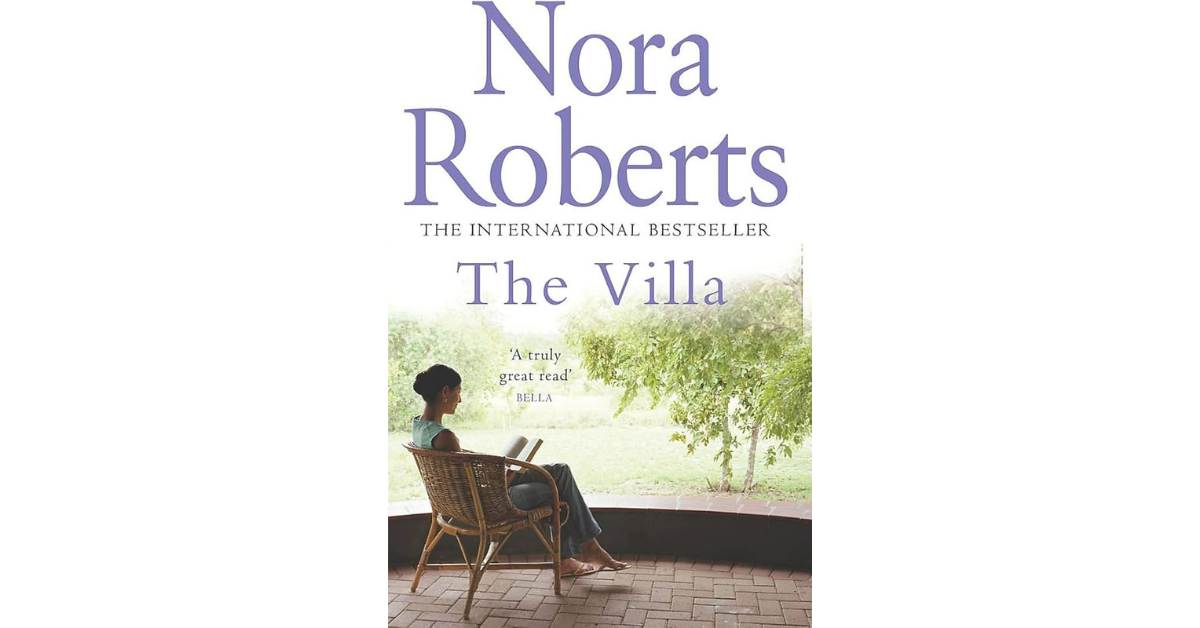
When I think about the moment I fell in love with romance novels, I think about The Villa by Nora Roberts. I was thirteen. It was summer in Seville, that thick kind of heat that makes everything slow down, the air heavy, the days stretching out forever. I found my mum’s copy lying around and picked it up because why not. Didn’t expect much. I’d always been a reader, but this was something else.
By the time I looked up, the sun was setting. I’d barely moved. The world inside that book had swallowed me whole.
Sophia Giambelli wasn’t just some woman falling in love. She was tough, sharp, ambitious. The kind of person who had things to do, who knew what she wanted and wasn’t about to let love just steamroll her life. But it happened anyway, tangled up in family expectations, legacy, everything she thought she had figured out. It was real in a way I hadn’t seen before. Love wasn’t the goal. It was part of everything else.
I finished the book in two days. Then I went looking for more.
Nora Roberts does something I still can’t get over. Her love stories aren’t just about romance. They’re about people. About who they are, who they want to be, how love fits into that (or doesn’t, until suddenly it does). Her women feel real—strong, complicated, sometimes stubborn to the point of disaster. Her men aren’t just love interests; they have their own lives, their own flaws, their own reasons for being the way they are. And the settings—Jesus.
That’s what really got me.
The vineyards in The Villa felt like you could walk through them, smell the earth, feel the heat bouncing off the stone. Born in Fire made me want to drop everything and move to Ireland. Her places don’t sit in the background. They breathe. They change the story just as much as the characters do.
And the romance itself? It’s not just about grand declarations or dramatic moments in the rain. It’s the way someone remembers how you take your coffee. The way a conversation shifts, just slightly, but enough that you know something’s different now. It’s the moments that feel small but mean everything.
If I hadn’t read The Villa that summer, I don’t know if I would have started writing. Maybe eventually, but not like this. Not with this understanding of what love stories can be, how much they can hold. I wanted to write characters who felt real, where the romance was tangled up in ambition, struggle, bad decisions, figuring things out too late or just in time. I wanted to write about places that felt alive, that made people ache to go there, even if they never had before. I wanted to make someone feel the way that book made me feel—like I had disappeared into another world and didn’t want to leave.
I still think about that summer, how I turned the last page and just sat there. How I realised, for the first time, that love stories weren’t just entertainment. They were a way of seeing the world.
And somehow, without meaning to, I knew.
This was what I was going to do.